I wrote my own book of linked stories by accident.
It started with one story about a girl named Leah, age 11. It was my first short story and took four months to write (not enough time, as it turned out), and took place in the basement of her building in New York City. When it was finished, I felt I knew Leah.
That seemed worth building on, and easier than starting fresh with a stranger, so I wrote a second story about her. This time she was twelve and up against a mean girl named Rainey.
Then I wrote a story about Rainey, at 13, with the man who abused her.
Then Leah again, with her best friend, at 15.
After five years I had a book—a novel-in-stories. It was called Normal People Don’t Live Like This. 
You could attribute the linkages to a total failure of imagination, as I admitted at the AWP panel on “Linking It Up: Working with Story Cycles, Linked Collections, and Novels-in-Stories” (with Anne Sanow, Clifford Garstang and Cathy Day). When Anne invited me onto that panel, I thought I knew what a link was: any person, object, situation, place that repeats between two or more short stories.
Still. I began rereading linked collections, among them Harriet Doerr’s Stones for Ibarra, Tim O’Brien’s The Things They Carried, Elissa Schappell’s Use Me, and Love Medicine, by Louise Erdrich, 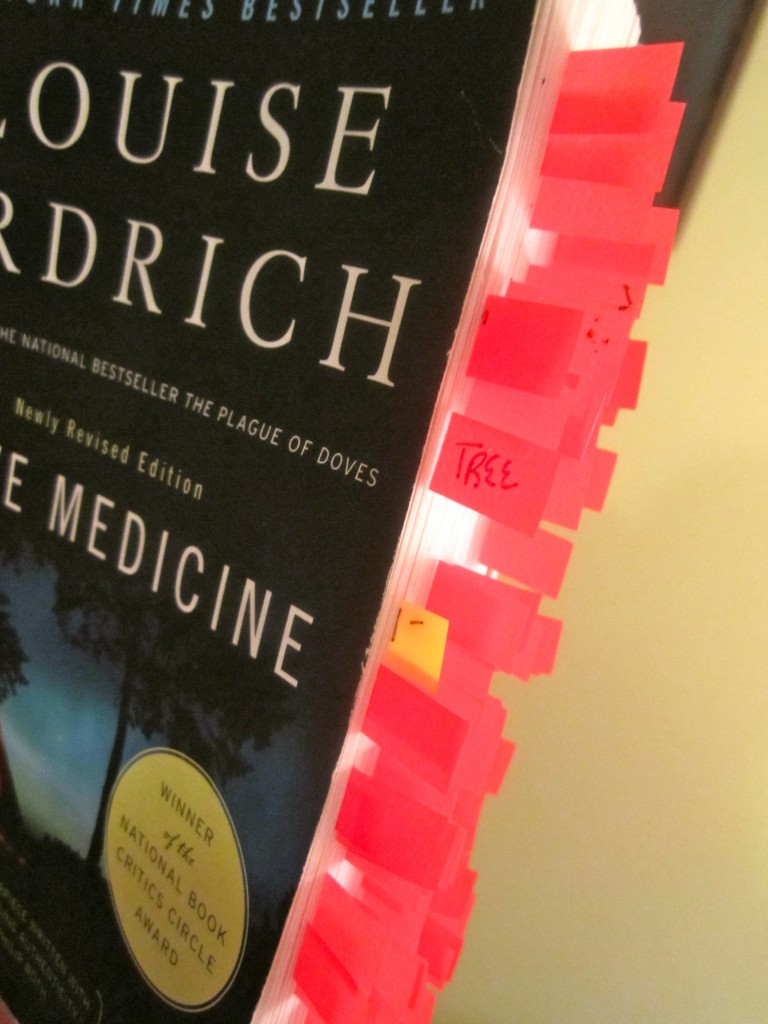 to see what I didn’t know. Sometimes, when you are in dire need of a craft lesson, one book opens itself up like a flower for your inspection, and for me, that book was Love Medicine. It revealed that stories can be crocheted together so intricately and dimensionally that they form a kind of lacework.
It made my own linked stories look like a child’s paper chain.
Here are just a few things Erdrich showed me. The examples won’t make much sense without the text—but close-reading has been the main way I’m able to limp forward as a writer.
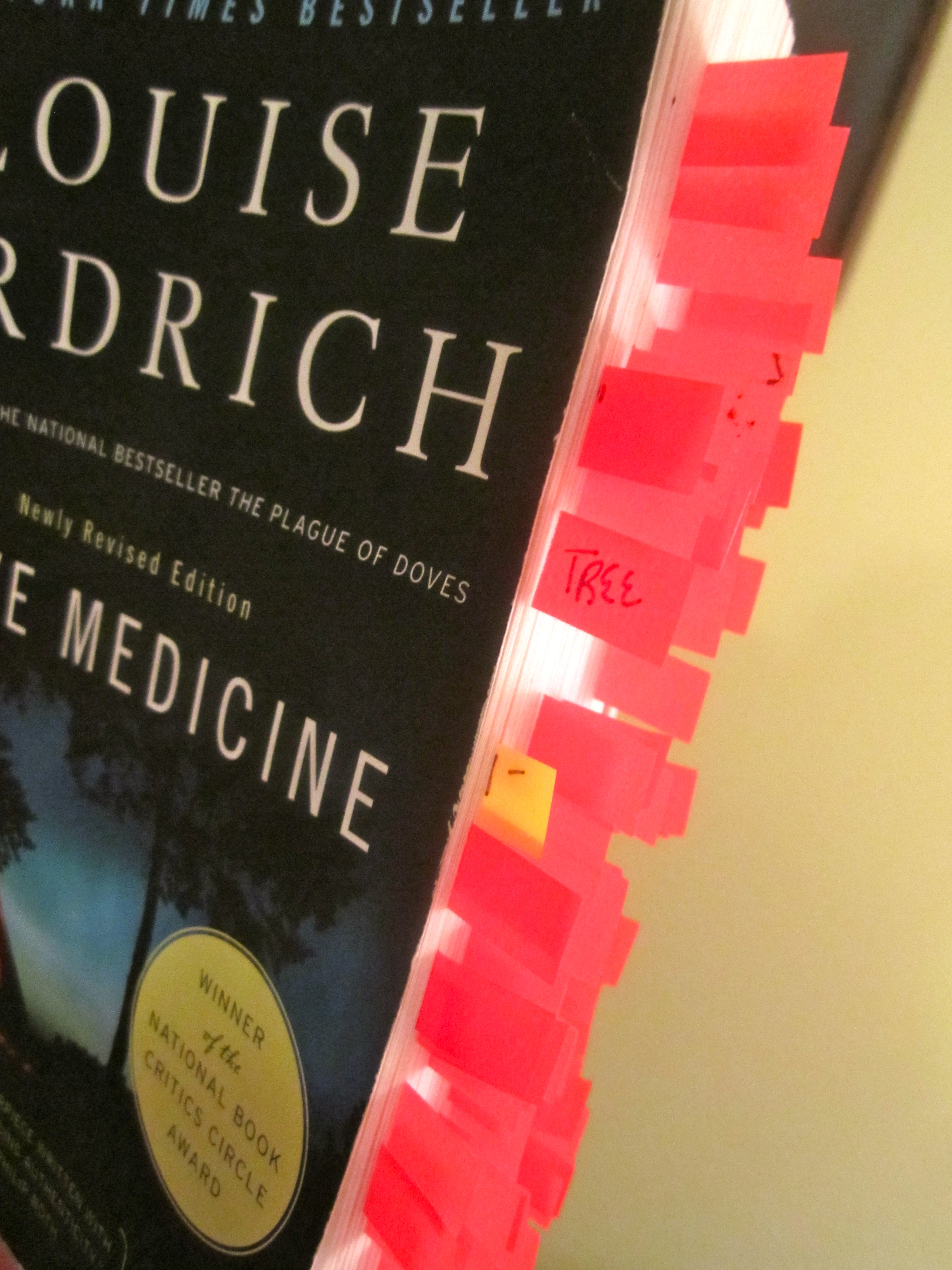
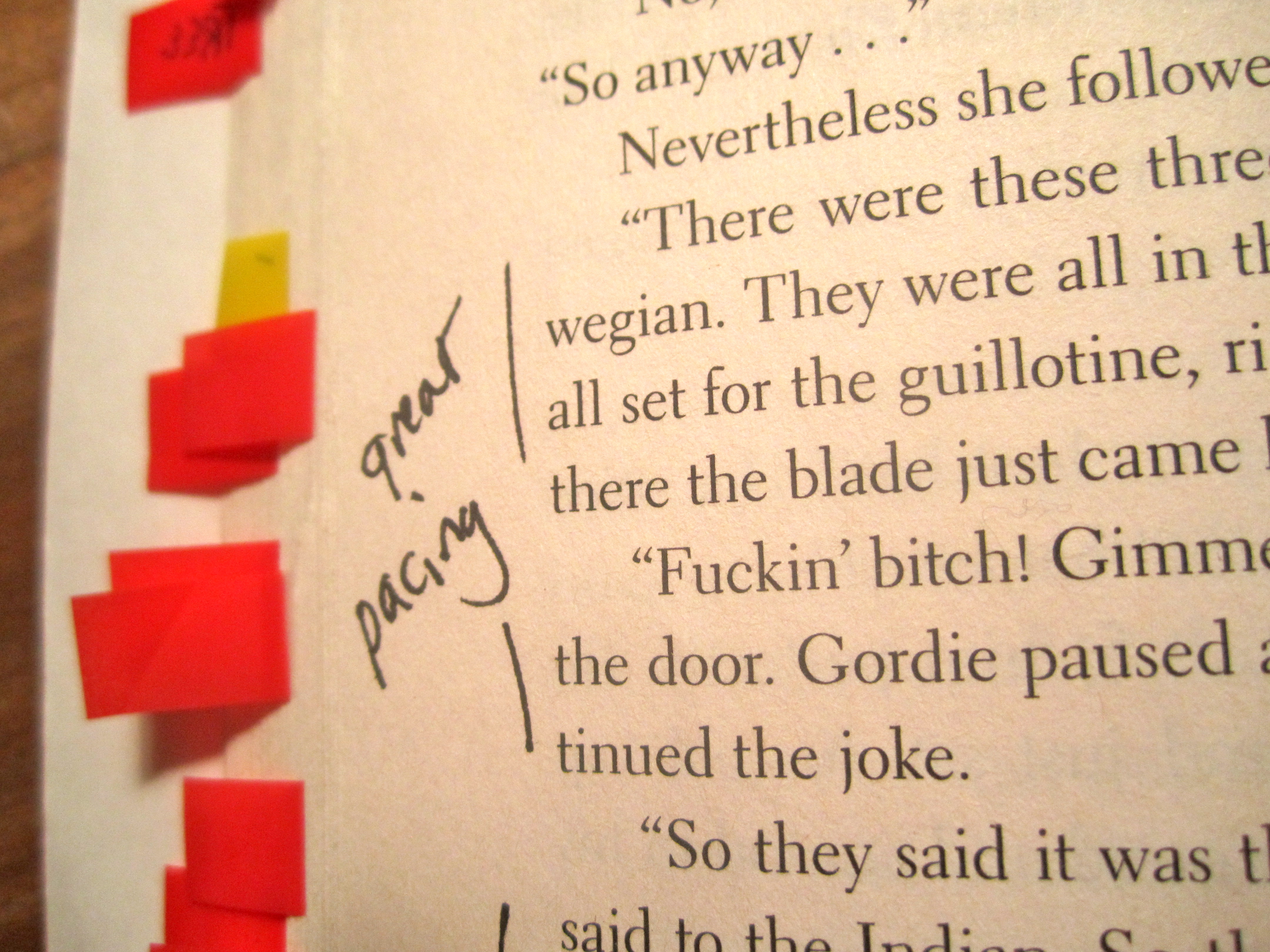
Note: the tiny Post-Its in my copy, above, note each appearance and reappearance of a link, except for the obvious: characters, who continually reappear, and place. Most of the book occurs on a Chippewa reservation in North Dakota.
Put the engine of the book up front. This story be the hub or contain the underlying or dominant link. (Cliff Garstang on our panel called this the umbrella story.)
The first and most powerful link in Love Medicine is a person: June Kashpaw, a Chippewa woman who dies early in the first story. June left behind a legitimate family, husband Gordie Kashpaw and son King; and an illegitimate family, lover Gerry Nanapush and son Lipsha. She also left behind a whole lot of tension. Lipsha doesn’t know who his parents are, but everyone else does.
The first story has broad swaths of backstory. I’m always bad at this. I’ve been reading lots of Andrea Barrett, because Dick Bausch says that Andrea Barrett calls this ELEGANT SUMMARY.
Every character in the book is impacted by June’s death, which is what makes this first story—in which she dies—the engine.
The central imagery—of water, and crossing water (which refers to both dying and coming home), begins here too.
Even when it started to snow she did not lose her sense of direction. Her feet grew numb, but she did not worry about the distance. The heavy winds couldn’t blow her off course. Even when her heart clenched and her skin turned crackling cold it didn’t matter, because the pure and naked part of her went on.
The snow fell deeper that Easter than it had in forty years, but June walked over it like water and came home.
This engine-up-front occurs in other linked collections, though not in mine, and has the effect of orienting the reader. We meet all the soldiers in the first and title story of The Things They Carried, and learn what matters most to each, and where they are and what they do.
In my collection’s first story, we meet a compelling character who reappears only once, then vanishes.
Make links kinetic so that they grow in power, and change, each time they recur.
Here is an Erdrich object-link that’s loaded and reloaded with emotional freight early on:
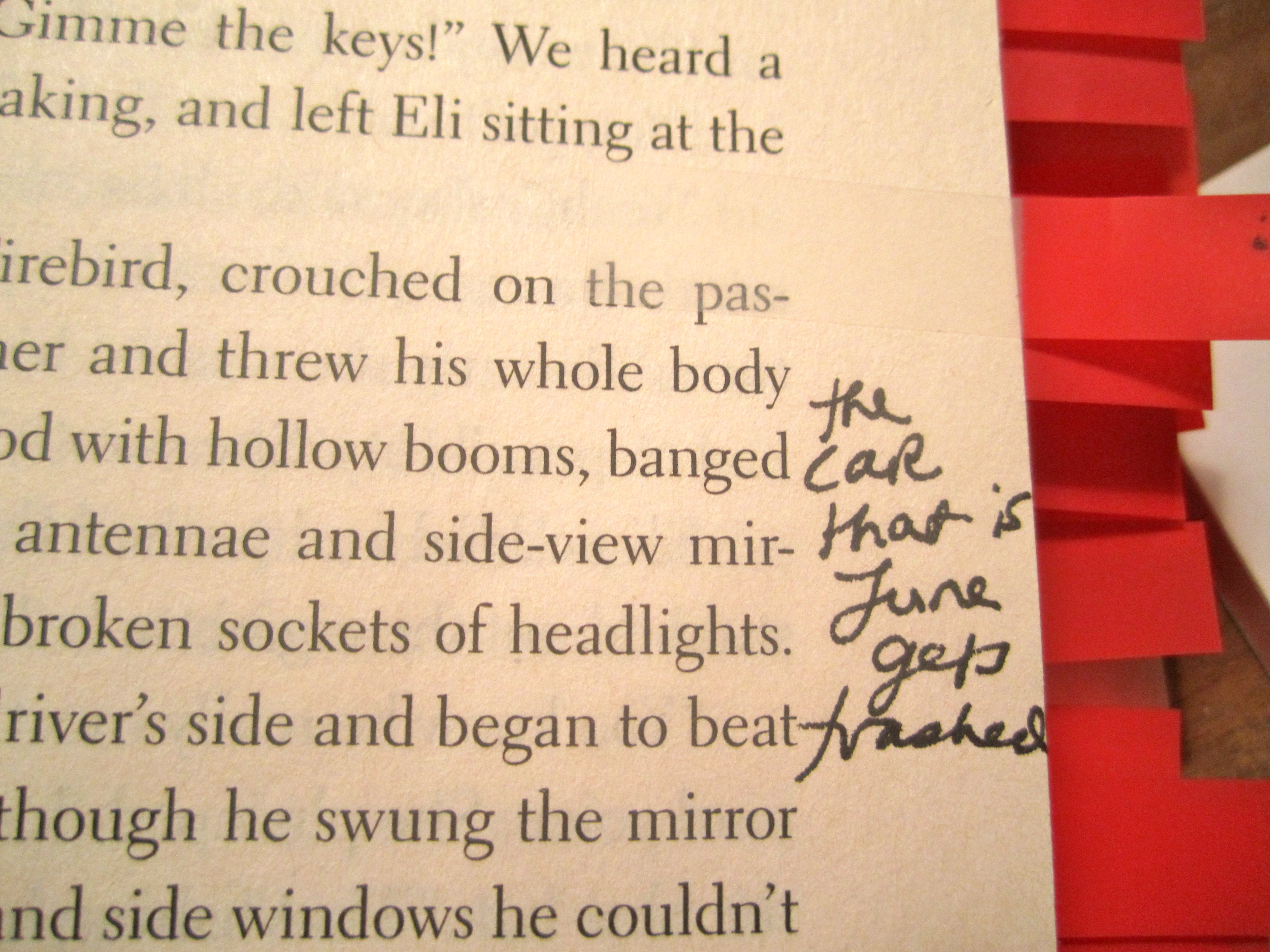
In the first story, June’s son, King Kashpaw, uses the insurance money from her death to buy a sportscar. Her relatives keep their distance, as if the car might be a ghost:
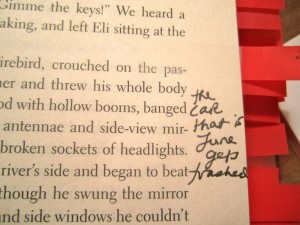
Nobody leaned against the shiny blue fenders, rested elbows on the hood, or set paper plates there while they ate. Aurelia didn’t even want to hear King’s tapes. It was as if the car was wired up to something. As if it might give off a shock when touched. Later, when Gordie came, he brushed the glazed chrome and gently tapped the tires with his toes. He would not go riding in it either, even though King urged his father to experience how smooth it ran.
Erdrich doesn’t stop there; she increases the freight. King drinks, becomes abusive, and chases his wife, Lynette, outside. Lynette locks herself in the sportscar, and King rips off a side mirror and beats the car. Finally Gordie, his father, grabs him to the ground in a hug and says,
“It’s her car. You’re June’s boy, King. Don’t cry.”
For as they lay there, welded in shock, King’s face was grinding deep into the cinders and his shoulders shook with heavy sobs. He screamed up through dirt at his father.
“It’s awful to be dead. Oh my God, she’s so cold.”
So when the car reappears near the end of the book, it really IS June; we believe that it means everything to King. But Erdrich doesn’t just use it as a link; she raises the stakes. Here’s how.
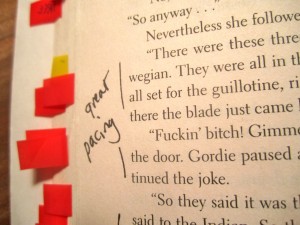
In the final story, Gerry (June’s lover) shows up in King’s apartment to get revenge. The two had been cellmates till Gerry escaped—and King ratted him out. Now King is terrified of Gerry. Lipsha’s in the apartment, too, and King hates Lipsha, his mother’s ill-gotten son.
Lipsha, for his part, has finally been told who his parents are: June and Gerry. He’s dying to declare himself to Gerry. And as tension builds, he’s handling a deck of cards, quietly nicking the edges with his fingernails.
Link no. 1: the sportscar. The men play poker. Lipsha insists they play for King’s car—for the car that is June, really. Lipsha wins the car.
Erdrich freights the link yet again by having the police show up, looking for Gerry. Gerry disappears out the window: just vanishes. Lipsha, driving away in King’s car, discovers that Gerry is in the trunk. He drives him all the way to Canada, to safety, “crossing water” with his newly-discovered father in the car that represents his newly-claimed mother.
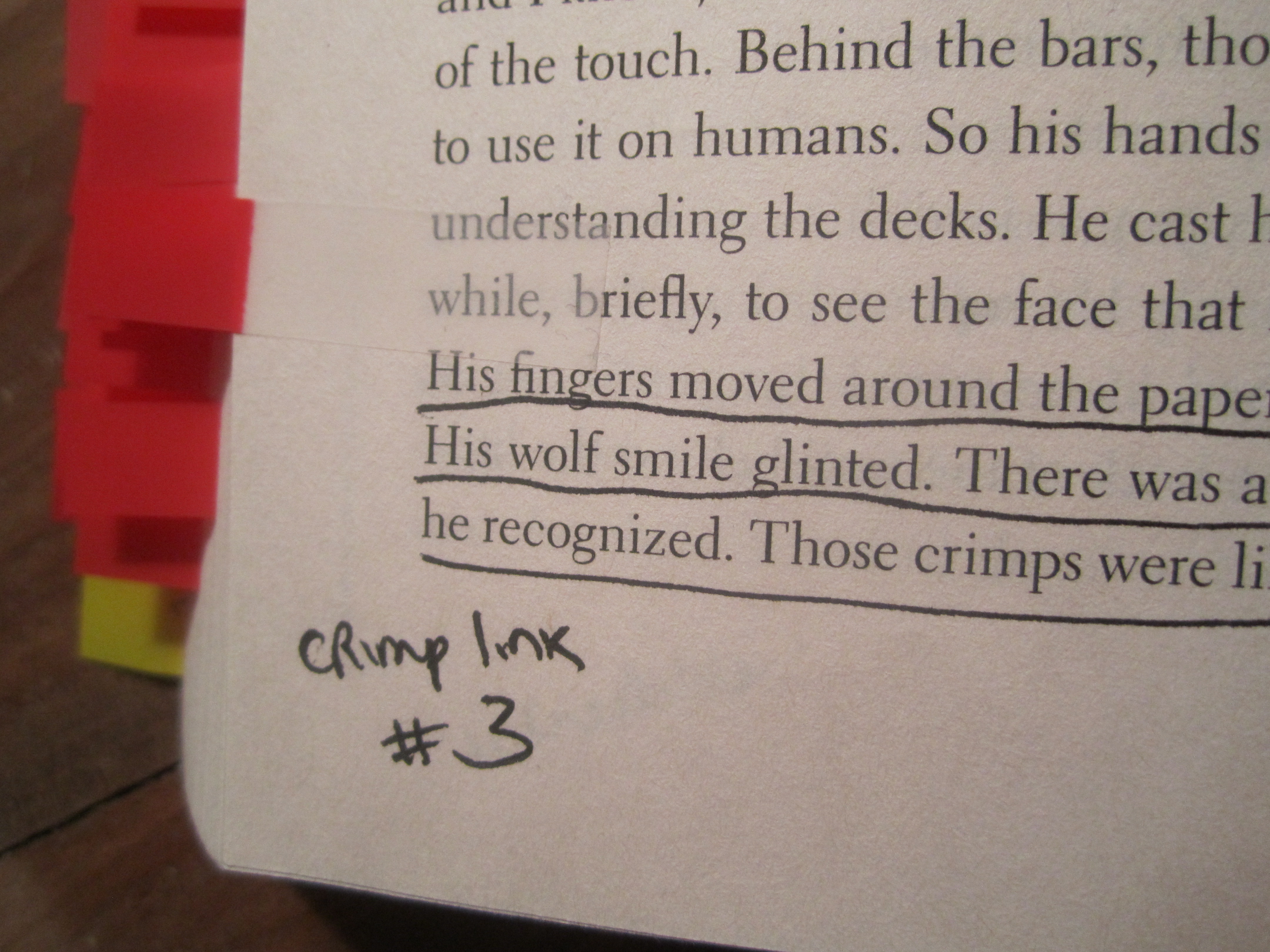
Link no. 2: the cards.
Lulu Lamartine, Lipsha’s grandmother, has lost most of her sight (though none of her spirit and sexuality) in her old age, and she tells us in story no. 15:
Sometimes I played cards with a magnifying glass and sometimes I just played by feel and what I could hear.
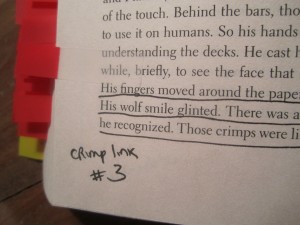 Well, she’s lying, in her friendly way. What she can “feel” are the little crimps or nicks she makes with her fingernails. In story 16, Lipsha, handling King’s cards, also starts crimping them. He learned the method, he tells us, from Lulu, when he worked in the senior center where she lives.
She’d learned to crimp, that is, to mark your cards with little scratches and folds as you play, when she started losing her eyesight.
Watch Erdrich freight the link. When Gerry shows up in King’s apartment and the mood grows ominous,
His fingers moved around the paper edges, found the nail nicks. His wolf smile glinted. There was a system to the crimping that he recognized. Those crimps were like a signature—his mother’s.
That’s how Gerry–who was in prison when his son was born and given away–confirms that Lipsha is that son.
Let the reappearance of a link reveal character, increase tension, or further the story.
Let links be kinetic by changing with every reappearance.
A second reference to an event can be a lie, a different version, the second half of a story that the reader thought was complete, or a misunderstanding.
Consider the burning of Lulu Lamartine’s house.
Nector Kashpaw, in story 7, leaves his wife for Lulu, finds Lulu’s house empty—and accidentally burns the house down by setting fire to a letter he meant to leave there.
Lulu—who is fond of stating the truth in ways that make her look good—says in story 15:
How do I know? How can I say it was Kashpaw who lit my house?
I can say so because of what I saw in his eyes when I looked deeply through him…My house was burning in his eyes, and I was trapped there, alone, on fire with my own fire.
That makes her sound deeply intuitive, but it’s not true.
In story 13, Lipsha overheard Nector Kashpaw tell Lulu in the Senior Citizens laundry room,
“The letter was what started the fire…I never would have done it.”
Nector’s half-senile, so Lipsha ignores this out-of-the-blue remark. But it’s clear that Lulu filed it away.
Or consider Henry Lamartine Jr.’s apparent suicide.
In story 10 (shattering—The Red Convertible), Henry has returned from Viet Nam and cannot readjust. He is out with his brother Lyman, who’s been trying to engage him with the gorgeous red Olds convertible they’d bought together, when Henry leaps into the rain-swollen river. It looks like a playful leap, but Henry doesn’t resist the current, and he drowns. To a Western reader it looks like suicide.
Lyman then pushes the car into the water. From the poetic writing he seems to be giving the car to his brother, as if unable to own it alone.
Five stories later, Lulu tells us more calculated, less poetic version of Lyman’s action.
“It was an accident,” Lyman said, coming in the door. He looked half gone himself. I threw an afghan on his shoulders.
“Don’t say nothing.” I led him over to a chair. He sat in shock.
“The car went in,” he said. “Out of control.” There was a false note in his voice and I knew he had planned to say this. I also knew that no accident would have taken Henry Junior’s life.
My point is that by making the link kinetic – changing the version of an event when the telling resumes – Erdrich reveals and deepens character. We understand now that Lyman wants to save Henry from appearing to be a suicide. We understand that Lulu does not like to talk about emotional matters, and also that she will be his accomplice in this. We understand that mother and son—Lyman and Lulu—can communicate a lot with few words. And, finally, we understand about Henry that no river could kill him without his consent.
That’s an enormous amount of information in very few lines. It also results from the fact that Louise Erdrich is fully in control of the gap between the first and second appearance of the link:
Engineer that gap. Make it shapely.
I could have given it more thought in Normal People.
In my collection, I show Leah, my protagonist, at age 15 with her father dying, and it’s pretty clear that this is shattering for her. Four years later she remembers the smell of her father’s shirts, which she saved. A couple of reviewers said, hey, wait—when did her father die? They felt stranded in the gap. I didn’t know what they meant till I close-read Love Medicine.
Louise Erdrich may let characters disappear for years and then reappear, but she establishes early on that these are her rules; the reader never feels abandoned between stories. It helps that she is writing about a large community, not one main character. This too lets her move around freely.
Tim O’Brien writes about all of his characters in his first story (“The Things They Carried”), then is free to circle around the group and write about individuals as he sees fit.
Imagery can be a link if it recurs often. Erdrich uses water and bridges; here are examples of the many water links.
Story 7: “I was a flood that strained bridges.”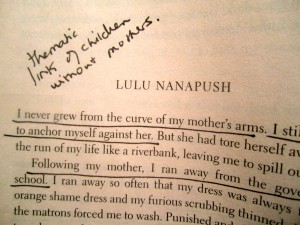
Story 8: The waxed floor “rolled and gleamed like a fire lake between us. And it deepened.”
Story 9: “It was, to Henry, as if she had crossed a deep river and disappeared.”
Story 10: “And then there is only the water, the sound of it going and running and going and running and running.”
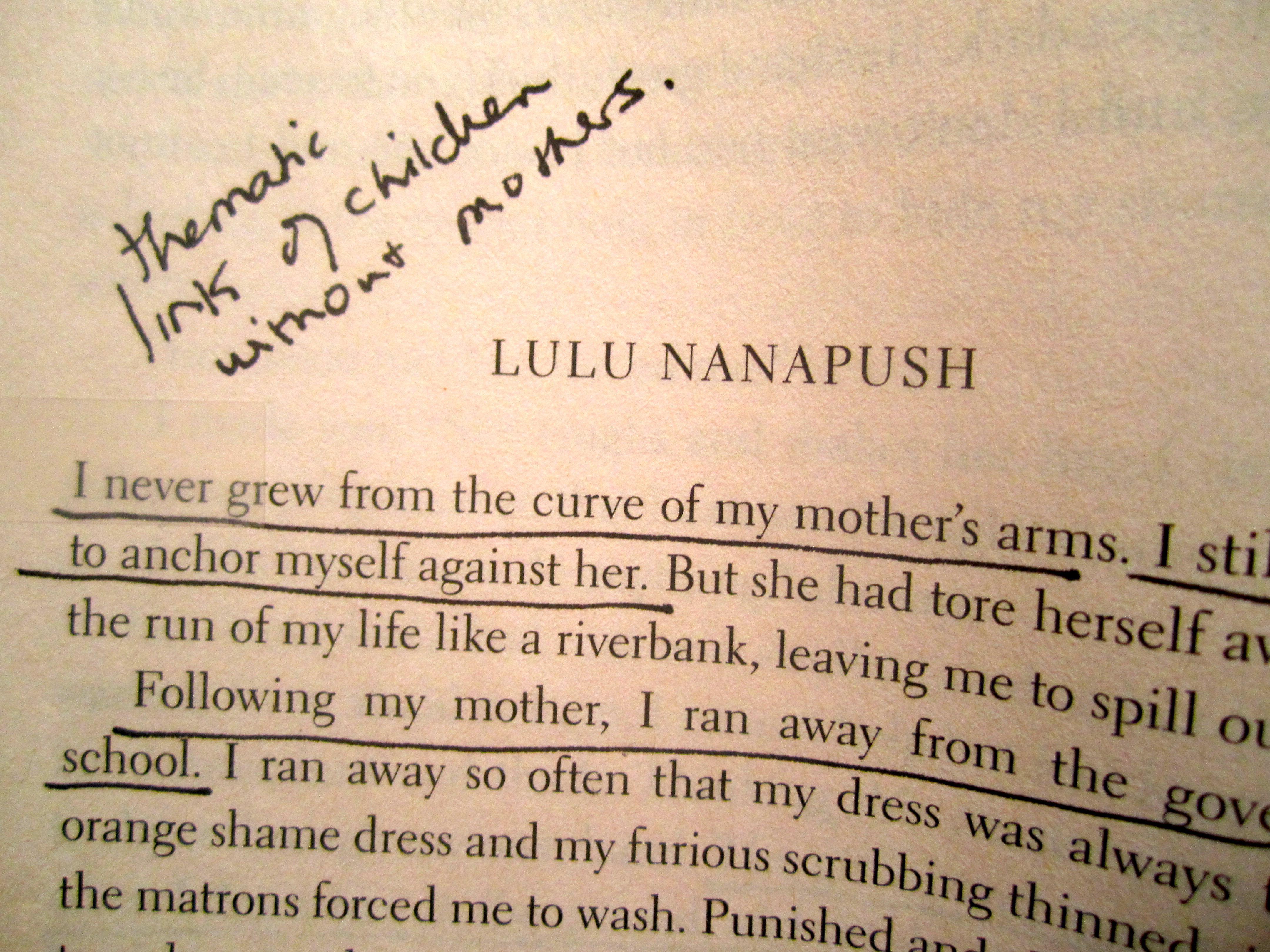
Theme can be a link. Erdrich’s children are often motherless, raised by adoptive mothers; her sons are sometimes without fathers. Death is shown as something to travel toward, the way “crossing water” can mean both dying and coming home.
Cathy Day, my co-panelist, has blogged on linked stories from a different angle.
 Erica likes a good time but she’s not rushing to grow up. Whereas Jasmine’s been lugging a suitcase of anger and hurt for months, since a friend of Michael’s took her virginity and ditched her.
 is like standing on a tapestry, stunned by jewel tones, so it’s hard to know which threads to scrutinize first. I think this will become the Away blog for awhile. Not systematic. Just passionate. Pulling one thread at a time.

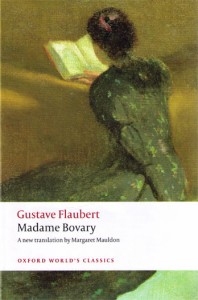 Critical, says Flannery, because “Flaubert had to create a believable village to put Emma in.”
 She savored the idea of a passerby bound to a lilac bush by invisible ropes of scent.
 The fragrance In the Library is redolent of
 would have been entranced.
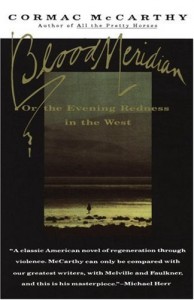 He wafts his hat and the lunar dome of his skull passes palely under the lamps and he swings about and takes possession of one of the fiddles and he pirouettes and makes a pass, two passes, dancing and fiddling all at once. His feet are light and nimble. He never sleeps. He says that he will never die. He dances in light and in shadow and he is a great favorite. He never sleeps, the judge. He is dancing, dancing. He says that he will never die.
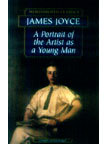 By the end of a 43-page chapter we have a 10-page scene packed with political allusions and adult complexities (observed and reported by a child, or from a POV that is part Stephen-child, part Joyce) that takes place during a single Christmas dinner.
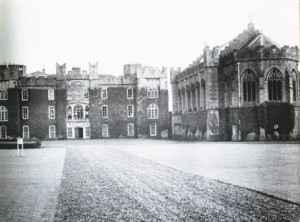 —a period of maybe three years, I’m guessing—in less than a page and a half. And it’s not just the three years. In that short space he tells us rhymes and a song of Stephen’s childhood and his Ireland, shows us Stephen’s mother playing a hornpipe on the piano so the little boy can dance; introduces Uncle Charles and Dante (Stephen’s aunt), makes it clear that Irish Republican politics were fiercely felt and discussed, and that the neighbors had a little girl whom Stephen planned to marry (a statement his mother and Dante make him apologize for)—we’re immersed in that house and its music and talk.
 I always have shoe trouble, but what-to-read-to-my-mother trouble. She’s in the I.C.U. at St. John’s Hospital, Santa Monica, “nearly comatose,” my father says.
 But often someone is going to die in Chekhov. Or is living in privation. Is that right? Packing under duress, I suddenly can’t remember a word of Chekhov (below), despite three translations on our shelves. Packing, I’m frantic for engaging books that won’t make my mom laugh—what if she chokes on a tube?—and in which no one lives in privation, or dies.
 So no privation.
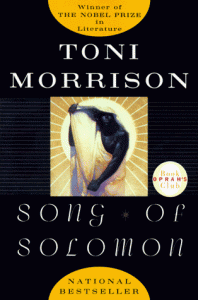 , which we both love, endlessly. I’ve read it twelve times. But my mother so connected with certain scenes, and re-tells them with such raw emotion, that I would not get through them. Pilate, at her daughter Hagar’s funeral, saying and singing the words: My baby girl. My baby girl. My baby girl. My baby girl. Looking into each person’s eyes in that church, saying it differently each time, asking it, praying it—my baby girl, my baby girl—and then calling out: And she was loved!

 Ultimately whatever the character observes will reveal her–sometimes what’s being described is secondary.